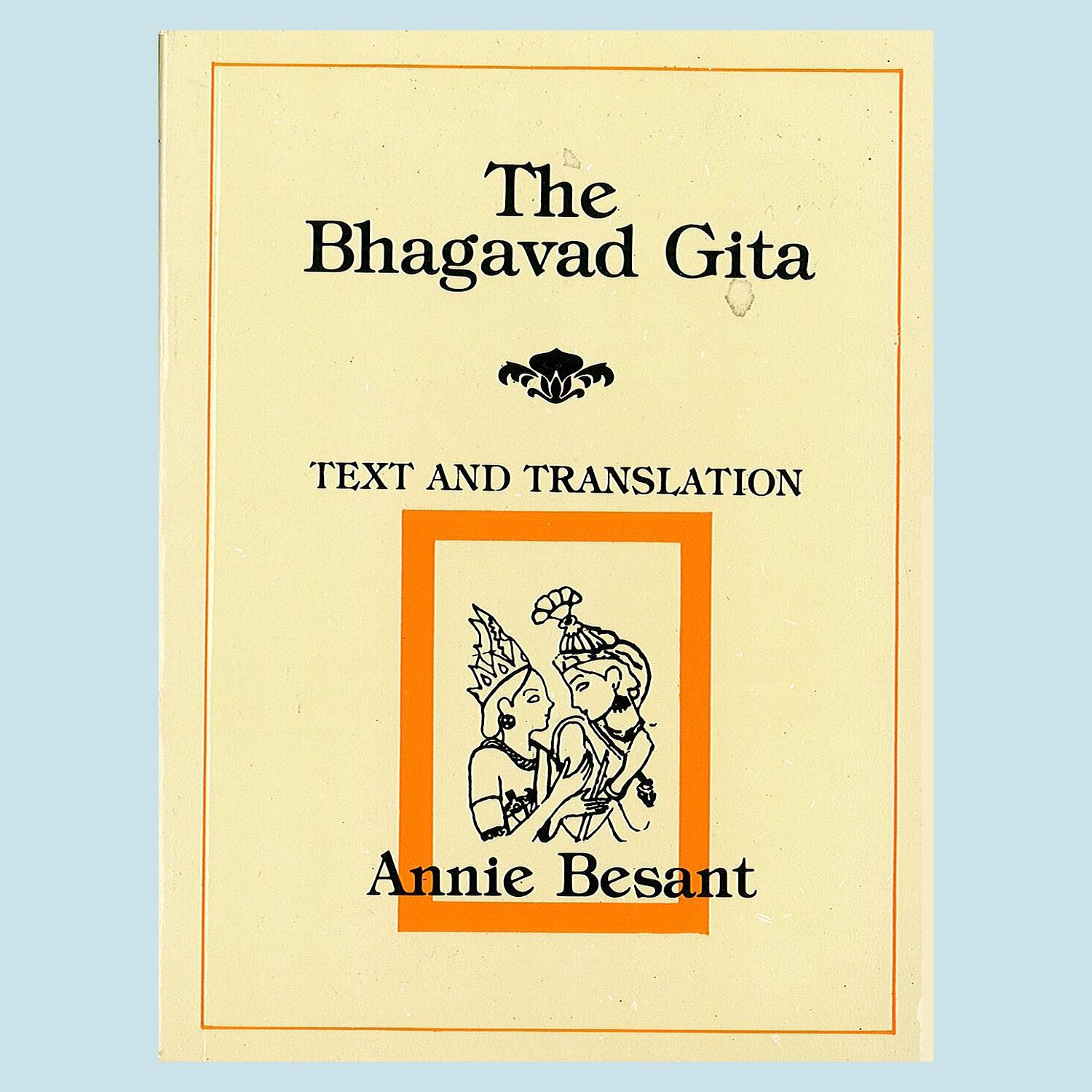
Bhagavad Gita 7610
SKU 9788170591757
$13.95
Sold out
Sold out
Save this product for later
Customer reviews
Reviews only from verified customers
No reviews yet. You can buy this product and be the first to leave a review.
Bhagavad Gita 7610
Product Details
Brand: TPH
Among the priceless teachings that may be found in the great Hindu poem of the Mahabharata, there is none so rare and precious as this, ‘The Lord’s Song’. Since it fell from the divine lips of Shri Krishna on the field of battle and stilled the surging emotions of his disciple and friend, how many troubled hearts has it quieted and strengthened, how many weary souls has it led to Him! It is meant to lift the aspirant from the lower levels of renunciation, where objects are renounced, to the loftier heights where desires are dead, and where the Yogi dwells in calm and ceaseless contemplation, while his body and mind are actively employed in discharging the duties that fall to his lot in life. That the spiritual man need not be a recluse, that union with the divine Life may be achieved and maintained in the midst of worldly affairs, that the obstacles to that union lie not outside us but within us – such is the central lesson of the BHAGAVAD-GITA. …… But, as all the acts of an Avatara are symbolical, we may pass from the outer to the inner planes, and see in the fight of Kurukshetra the battlefield of the soul, and, in the sons of Dhritarashtra, enemies it meets in its progress; Arjuna becomes the type of the struggling soul of the disciple, and Shri Krishna is the Logos of the soul. Thus the teaching of the ancient battlefield gives guidance in all later days, and trains the aspiring soul in treading the steep and thorny path that leads to peace. To all such souls in East and West come these divine lessons, for the path is one, though it has many names, and all souls seek the same goal, though they many not realize their unity………” This book is an imprint of the Theosophical Publishing House, Adyar, and is imported from India.
About the author: Born in London in 1847, Annie Besant was only five years old when her father died. Unable to care for her, Annie’s mother sent her to live with a friend, where she was privately educated. At the age of 19, she married the Rev. Frank Besant and by the age of 23 had two children. When Annie began questioning her religious beliefs, Frank Besant ordered her to leave. The two divorced and Frank won custody of both children. Completely rejecting Christianity in 1874, Annie joined the Secular Society and began writing articles on marriage and women’s rights for the radical National Reformer. She helped form a Matchgirls Union in 1888 to defend the rights of women workers, and led a strike against the Bryant & May match factory. She also joined the socialist group, the Fabian Society, where she became friends with Walter Crane and George Bernard Shaw. In 1889, she contributed an article to the influential book, Fabian Essays, and joined the Theosophical Society, soon moving to the Society's international headquarters at Adyar, Chennai, India. Even while in India, she remained active in the women’s rights movement and continued to write letters to British newspapers advocating women’s suffrage. While in India, Annie worked with Gandhi, who credited her with "awakening India from her deep slumber." She also led the Hindu nationalist movement, founded Central Hindu College at Barares, and organized the Indian Home Rule League, becoming president in 1916. During the First World War, she was interned by British authorities. Elected president of the Indian National Congress in 1917 and general secretary of the National Convention of India in 1923, she became a well-known figure remembered by many Indians to this day. At the same time, she worked tirelessly for the Theosophical Society, serving as the second President from 1907 until her death in 1933.The keynote of all her varied activities was her unswerving loyalty to Truth. As she said, "She (Truth) may lead me into the wilderness, yet I must follow her; she may strip me of all love, yet I must pursue her; though she slay me, yet will I trust in her; and I ask no other epitaph on my tomb but 'She tried to follow Truth'." Annie Besant died in India in 1933, the author of more than 40 books. Although she had lectured widely on Theosophy, she may be best remembered for her sponsorship of the great spiritual teacher, Krishnamurti. Proclaiming the "Coming of the World Teacher," she adopted Jiddu Krishnamurti in 1911 and sent him to England to be educated. She remained his legal guardian until 1921.
Powered by Lightspeed
Display prices in:USD