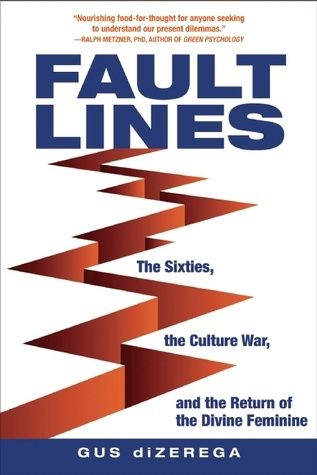
Fault Lines: The Sixties, the Culture War, and the Return of the Divine Feminine
Share
SKU 9780835609180
$18.95
In stock: 96 available
Fault Lines: The Sixties, the Culture War, and the Return of the Divine Feminine
Share
Product details
ISBN: 9780835609180
Brand: Quest Books (IL)
The United States is suffering its greatest upheaval since the Civil War—politically, economically, socially and religiously. In Fault Lines: The Sixties, the Culture War, and the Return of the Divine Feminine, author Gus diZerega explores the complex causes leading us to this point, comparing them to giant fault lines that, when they erupt, create enormous disturbance and in time new landscapes. In 1960 the American political landscape seemed as peaceful as California’s hills, valleys, and bays. Since then the country’s deepest fractures have begun to shift. Our land has entered upon a time of growing upheaval in every dimension of our common life. Fault Lines argues three basic faults are causing this disruption. With great clarity and vision, diZerega traces the disruption first to America's first countercultural movement originating in the antebellum South and coming into later conflict with the "counterculture" of the 60s that continues now in phenomena like Burning Man, second, to the crumbling of the moral foundation birthed by the Enlightenment, leading to today’s nihilism, and third, to the roots of what constitutes civilization itself, as modernity has dissolved its own rootedness in ways of life thousands of years old. But within this third fault lies hope, as it has opened up the promise of a new society built on different premises based more in equality, sacred feminine values and spiritual immanence. Whether the prevailing oligarchy will abort this transformation is the question of our time, claims diZerega. Fault Lines enables those of us living through these changes now to understand the powerful forces shaping our lives and calling on us for a response.
312 pages
About the author: Gus diZerega financed his Ph.D. in Political Theory as an artist in Berkeley, California, joking he was a “starving academic who does art for a living.†His pen and inks appeared on envelopes, stationery and note cards, and for many years were widely sold in stores across the country. Finishing his Ph.D. in Political Theory at UC Berkeley in 1984, he anticipated a normal academic career would follow. But weeks after the dissertation was signed, he dared a customer of his art to show him “real magic,†for he had claimed to be a magician. DiZerega thought he could not do so. DiZerega was wrong. The resulting intellectual crisis – for diZerega’s entire academic work had been firmly within the mainstream, Western scientific tradition - precipitated years of divided study as he taught university courses in his fields, published in the scholarly press, and simultaneously worked closely with teachers in the Wiccan, Shamanic, Buddhist, and African Diasporic spiritual traditions. diZerega found that work to be as challenging and demanding as obtaining a Ph.D. at one of the world’s pre-eminent institutions, UC Berkeley. Today, he believes he can integrate the best of what he learned in both traditions of thought and practice. He is a Third Degree Elder in Gardnerian Wicca, and has trained and initiated others, he has studied six years under Brazilian shaman Antonio Costa e Silva, and has conducted healing circles and taught these methods widely, where they have been attended by medical doctors, nurses, and others in the healing field. DiZerega has also participated for many years in Interfaith work between the Pagan and other spiritual communities, including working in the United Religions Initiative and giving talks to the Berkeley Area Interfaith Council. diZerega is author of books and many articles, chapters and newspaper columns on political and environmental issues. He has helped organize international conferences on the role of emergent order phenomena on the social sciences and exploring the further reaches of thought opened up by Nobel Laureate F. A. Hayek, and has been invited internationally to teach on these topics.
Customer reviews
Customer reviews
Reviews only from verified customers
No reviews yet. You can buy this product and be the first to leave a review.
Powered by Lightspeed
Display prices in:USD