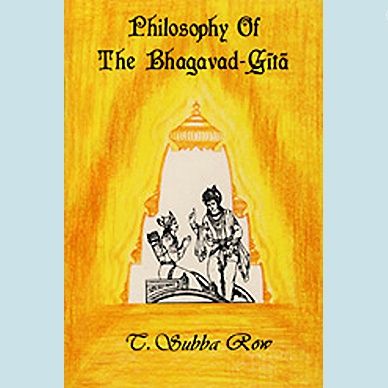
Philosophy Of The Bhagavad Gita 7662
Share
SKU 9788170592433
$11.25
In stock: 9 available
Philosophy Of The Bhagavad Gita 7662
Share
Product details
ISBN: 9788170592433
Brand: Theosophical Publishing House, Adyar (Madras, India)
The Bhagavad–gita, as it at present stands, is essentially practical in its character and teachings, but these teachings will not be understood unless their philosophical basis is constantly kept in view. The Bhagavad–gita presupposes certain premises which are not explained at length, they are simply alluded to. Here Subba Row presents an original explanation of the underlying philosophy of the Gita This book is an imprint of the Theosophical Publishing House, Adyar, and is imported from India.
About the author: T. Subba Row was a Vedantin scholar and early member of the Theosophical Society. He was closely associated with H. P. Blavatsky suring her residency in India. He was born in 1856 at Cocanda, on the Coromandel Coast of India, to a prominent Brahman family, and remained a preacticing Brahman throughout his life. Upon receiving his B.A. and B.L. at Madras, he entered the legal profession in his mid-twenties, having shown no interest in mystical subjects. However, his contact with H. P. Blavatsky and H.S. Olcott in the early 1880s seems to have acted as a catalyst in opening up his innate store of metaphysical knowledge, particularly of Sanskrit literature. In spite of his writing talent and great learning, Subba Row produced relatively few works, as he refused to divulge the Brahamanical teachings to outsiders, especially to Europeans. This profound scholar died suddenly in 1890, just under the age of 34.
Customer reviews
Customer reviews
Reviews only from verified customers
No reviews yet. You can buy this product and be the first to leave a review.
Powered by Lightspeed
Display prices in:USD